commit aee77e4acc upstream.

The r8169 driver currently limits the DMA burst for TX to 1024 bytes. I have
a box where this prevents the interface from using the gigabit line to its full
potential. This patch solves the problem by setting TX_DMA_BURST to unlimited.

The box has an ASRock B75M motherboard with on-board RTL8168evl/8111evl
(XID 0c900880). TSO is enabled.

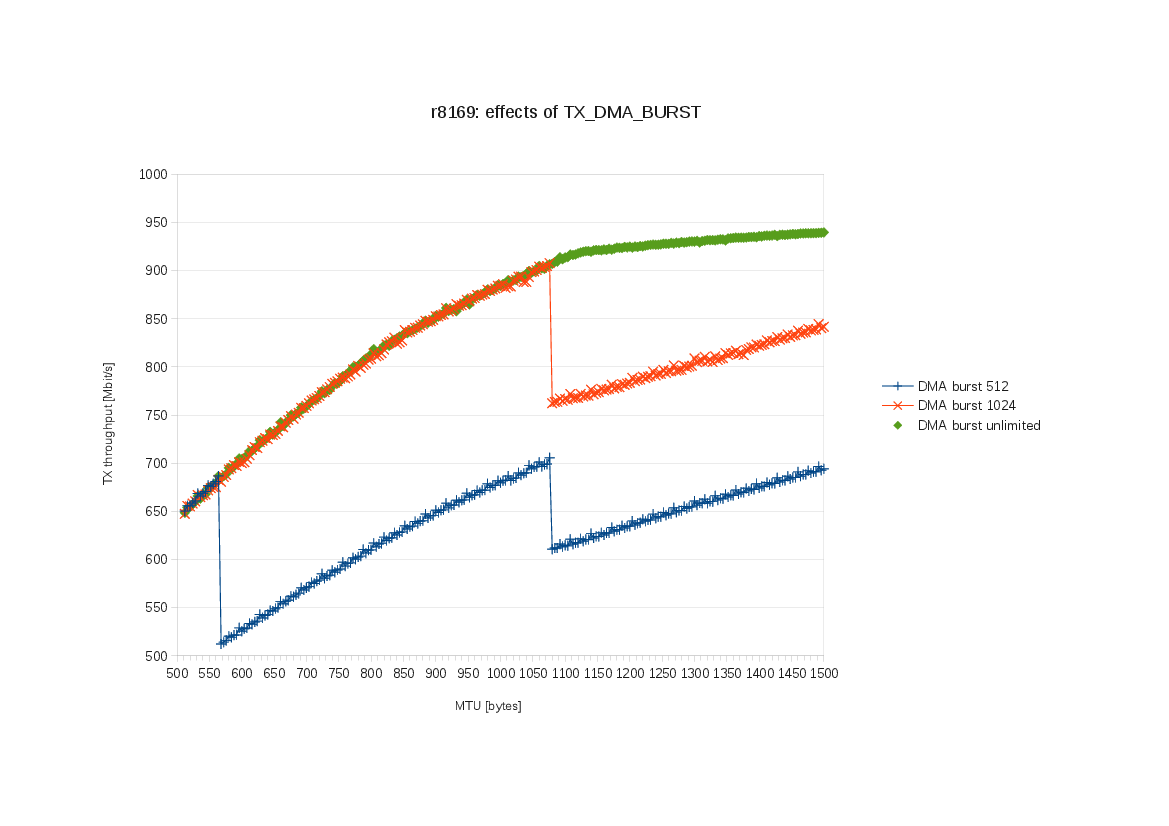
I used netperf (TCP_STREAM test) to measure the dependency of TX throughput
on MTU. I did it for three different values of TX_DMA_BURST ('5'=512, '6'=1024,
'7'=unlimited). This chart shows the results:
http://michich.fedorapeople.org/r8169/r8169-effects-of-TX_DMA_BURST.png

Interesting points:
 - With the current DMA burst limit (1024):
   - at the default MTU=1500 I get only 842 Mbit/s.
   - when going from small MTU, the performance rises monotonically with
     increasing MTU only up to a peak at MTU=1076 (908 MBit/s). Then there's
     a sudden drop to 762 MBit/s from which the throughput rises monotonically
     again with further MTU increases.
 - With a smaller DMA burst limit (512):
   - there's a similar peak at MTU=1076 and another one at MTU=564.
 - With unlimited DMA burst:
   - at the default MTU=1500 I get nice 940 Mbit/s.
   - the throughput rises monotonically with increasing MTU with no strange
     peaks.

Notice that the peaks occur at MTU sizes that are multiples of the DMA burst
limit plus 52. Why 52? Because:
  20 (IP header) + 20 (TCP header) + 12 (TCP options) = 52

The Realtek-provided r8168 driver (v8.032.00) uses unlimited TX DMA burst too,
except for CFG_METHOD_1 where the TX DMA burst is set to 512 bytes.
CFG_METHOD_1 appears to be the oldest MAC version of "RTL8168B/8111B",
i.e. RTL_GIGA_MAC_VER_11 in r8169. Not sure if this MAC version really needs
the smaller burst limit, or if any other versions have similar requirements.

Signed-off-by: Michal Schmidt <mschmidt@redhat.com>
Acked-by: Francois Romieu <romieu@fr.zoreil.com>
Signed-off-by: David S. Miller <davem@davemloft.net>
Signed-off-by: Ben Hutchings <ben@decadent.org.uk>
commit b00e69dee4 upstream.

This regression was spotted between Debian squeeze and Debian wheezy
kernels (respectively based on 2.6.32 and 3.2). More info about
Wake-on-LAN issues with Realtek's 816x chipsets can be found in the
following thread: http://marc.info/?t=132079219400004

Probable regression from d4ed95d796e5126bba51466dc07e287cebc8bd19;
more chipsets are likely affected.

Tested on top of a 3.2.23 kernel.

Reported-by: Florent Fourcot <florent.fourcot@enst-bretagne.fr>
Tested-by: Florent Fourcot <florent.fourcot@enst-bretagne.fr>
Hinted-by: Francois Romieu <romieu@fr.zoreil.com>
Signed-off-by: Cyril Brulebois <kibi@debian.org>
Signed-off-by: David S. Miller <davem@davemloft.net>
Signed-off-by: Ben Hutchings <ben@decadent.org.uk>
commit 5f5b331d5c upstream.

The issue occurs when eCryptfs is mounted with a cipher supported by
the crypto subsystem but not by eCryptfs. The mount succeeds and an
error does not occur until a write. This change checks for eCryptfs
cipher support at mount time.

Resolves Launchpad issue #338914, reported by Tyler Hicks in 03/2009.
https://bugs.launchpad.net/ecryptfs/+bug/338914

Signed-off-by: Tim Sally <tsally@atomicpeace.com>
Signed-off-by: Tyler Hicks <tyhicks@canonical.com>
Signed-off-by: Ben Hutchings <ben@decadent.org.uk>
commit 069ddcda37 upstream.

When the eCryptfs mount options do not include '-o acl', but the lower
filesystem's mount options do include 'acl', the MS_POSIXACL flag is not
flipped on in the eCryptfs super block flags. This flag is what the VFS
checks in do_last() when deciding if the current umask should be applied
to a newly created inode's mode or not. When a default POSIX ACL mask is
set on a directory, the current umask is incorrectly applied to new
inodes created in the directory. This patch ignores the MS_POSIXACL flag
passed into ecryptfs_mount() and sets the flag on the eCryptfs super
block depending on the flag's presence on the lower super block.

Additionally, it is incorrect to allow a writeable eCryptfs mount on top
of a read-only lower mount. This missing check did not allow writes to
the read-only lower mount because permissions checks are still performed
on the lower filesystem's objects but it is best to simply not allow a
rw mount on top of ro mount. However, a ro eCryptfs mount on top of a rw
mount is valid and still allowed.

https://launchpad.net/bugs/1009207

Signed-off-by: Tyler Hicks <tyhicks@canonical.com>
Reported-by: Stefan Beller <stefanbeller@googlemail.com>
Cc: John Johansen <john.johansen@canonical.com>
Signed-off-by: Ben Hutchings <ben@decadent.org.uk>
[ Upstream commit 60713a0ca7 ]

As documented in RFC4861 (Neighbor Discovery for IP version 6) 7.2.6.,
unsolicited neighbour advertisements should be sent to the all-nodes
multicast address.

Signed-off-by: Hannes Frederic Sowa <hannes@stressinduktion.org>
Signed-off-by: David S. Miller <davem@davemloft.net>
Signed-off-by: Ben Hutchings <ben@decadent.org.uk>
[ Upstream commit a3d744e995 ]

Due to a NULL dereference, the following patch is causing oops
in normal trafic condition:

commit c0de08d042
Author: Eric Leblond <eric@regit.org>
Date:   Thu Aug 16 22:02:58 2012 +0000

    af_packet: don't emit packet on orig fanout group

This buggy patch was a feature fix and has reached most stable
branches.

When skb->sk is NULL and when packet fanout is used, there is a
crash in match_fanout_group where skb->sk is accessed.
This patch fixes the issue by returning false as soon as the
socket is NULL: this correspond to the wanted behavior because
the kernel as to resend the skb to all the listening socket in
this case.

Signed-off-by: Eric Leblond <eric@regit.org>
Signed-off-by: David S. Miller <davem@davemloft.net>
Signed-off-by: Ben Hutchings <ben@decadent.org.uk>
[ Upstream commit 789336360e ]

When creating an L2TPv3 Ethernet session, if register_netdev() should fail for
any reason (for example, automatic naming for "l2tpeth%d" interfaces hits the
32k-interface limit), the netdev is freed in the error path.  However, the
l2tp_eth_sess structure's dev pointer is left uncleared, and this results in
l2tp_eth_delete() then attempting to unregister the same netdev later in the
session teardown.  This results in an oops.

To avoid this, clear the session dev pointer in the error path.

Signed-off-by: Tom Parkin <tparkin@katalix.com>
Signed-off-by: David S. Miller <davem@davemloft.net>
Signed-off-by: Ben Hutchings <ben@decadent.org.uk>
[ Upstream commit 8f363b77ee ]

Reading TCP stats when using TCP Illinois congestion control algorithm
can cause a divide by zero kernel oops.

The division by zero occur in tcp_illinois_info() at:
 do_div(t, ca->cnt_rtt);
where ca->cnt_rtt can become zero (when rtt_reset is called)

Steps to Reproduce:
 1. Register tcp_illinois:
     # sysctl -w net.ipv4.tcp_congestion_control=illinois
 2. Monitor internal TCP information via command "ss -i"
     # watch -d ss -i
 3. Establish new TCP conn to machine

Either it fails at the initial conn, or else it needs to wait
for a loss or a reset.

This is only related to reading stats.  The function avg_delay() also
performs the same divide, but is guarded with a (ca->cnt_rtt > 0) at its
calling point in update_params().  Thus, simply fix tcp_illinois_info().

Function tcp_illinois_info() / get_info() is called without
socket lock.  Thus, eliminate any race condition on ca->cnt_rtt
by using a local stack variable.  Simply reuse info.tcpv_rttcnt,
as its already set to ca->cnt_rtt.
Function avg_delay() is not affected by this race condition, as
its called with the socket lock.

Cc: Petr Matousek <pmatouse@redhat.com>
Signed-off-by: Jesper Dangaard Brouer <brouer@redhat.com>
Acked-by: Eric Dumazet <edumazet@google.com>
Acked-by: Stephen Hemminger <shemminger@vyatta.com>
Signed-off-by: David S. Miller <davem@davemloft.net>
Signed-off-by: Ben Hutchings <ben@decadent.org.uk>
[ Upstream commit 39707c2a3b ]

Driver anchors the tx urbs and defers the urb submission if
a transmit request comes when the interface is suspended.
Anchoring urb increments the urb reference count. These
deferred urbs are later accessed by calling usb_get_from_anchor()
for submission during interface resume. usb_get_from_anchor()
unanchors the urb but urb reference count remains same.
This causes the urb reference count to remain non-zero
after usb_free_urb() gets called and urb never gets freed.
Hence call usb_put_urb() after anchoring the urb to properly
balance the reference count for these deferred urbs. Also,
unanchor these deferred urbs during disconnect, to free them
up.

Signed-off-by: Hemant Kumar <hemantk@codeaurora.org>
Acked-by: Oliver Neukum <oneukum@suse.de>
Signed-off-by: David S. Miller <davem@davemloft.net>
Signed-off-by: Ben Hutchings <ben@decadent.org.uk>
[ Upstream commit 14edd87dc6 ]

Commit a02e4b7dae4551(Demark default hoplimit as zero) only changes the
hoplimit checking condition and default value in ip6_dst_hoplimit, not
zeros all hoplimit default value.

Keep the zeroing ip6_template_metrics[RTAX_HOPLIMIT - 1] to force it as
const, cause as a37e6e344910(net: force dst_default_metrics to const
section)

Signed-off-by: Li RongQing <roy.qing.li@gmail.com>
Signed-off-by: David S. Miller <davem@davemloft.net>
Signed-off-by: Ben Hutchings <ben@decadent.org.uk>
[ Upstream commit a3374c42aa ]

tcp_ioctl() tries to take into account if tcp socket received a FIN
to report correct number bytes in receive queue.

But its flaky because if the application ate the last skb,
we return 1 instead of 0.

Correct way to detect that FIN was received is to test SOCK_DONE.

Reported-by: Elliot Hughes <enh@google.com>
Signed-off-by: Eric Dumazet <edumazet@google.com>
Cc: Neal Cardwell <ncardwell@google.com>
Cc: Tom Herbert <therbert@google.com>
Signed-off-by: David S. Miller <davem@davemloft.net>
Signed-off-by: Ben Hutchings <ben@decadent.org.uk>
[ Upstream commit 6d772ac557 ]

On some suspend/resume operations involving wimax device, we have
noticed some intermittent memory corruptions in netlink code.

Stéphane Marchesin tracked this corruption in netlink_update_listeners()
and suggested a patch.

It appears netlink_release() should use kfree_rcu() instead of kfree()
for the listeners structure as it may be used by other cpus using RCU
protection.

netlink_release() must set to NULL the listeners pointer when
it is about to be freed.

Also have to protect netlink_update_listeners() and
netlink_has_listeners() if listeners is NULL.

Add a nl_deref_protected() lockdep helper to properly document which
locks protects us.

Reported-by: Jonathan Kliegman <kliegs@google.com>
Signed-off-by: Eric Dumazet <edumazet@google.com>
Cc: Stéphane Marchesin <marcheu@google.com>
Cc: Sam Leffler <sleffler@google.com>
Signed-off-by: David S. Miller <davem@davemloft.net>
Signed-off-by: Ben Hutchings <ben@decadent.org.uk>
commit b0a8cc58e6 upstream.

In kswapd(), set current->reclaim_state to NULL before returning, as
current->reclaim_state holds reference to variable on kswapd()'s stack.

In rare cases, while returning from kswapd() during memory offlining,
__free_slab() and freepages() can access the dangling pointer of
current->reclaim_state.

Signed-off-by: Takamori Yamaguchi <takamori.yamaguchi@jp.sony.com>
Signed-off-by: Aaditya Kumar <aaditya.kumar@ap.sony.com>
Acked-by: David Rientjes <rientjes@google.com>
Signed-off-by: Andrew Morton <akpm@linux-foundation.org>
Signed-off-by: Linus Torvalds <torvalds@linux-foundation.org>
Signed-off-by: Ben Hutchings <ben@decadent.org.uk>
commit 6ce377afd1 upstream.

Commit 4439647 ("xfs: reset buffer pointers before freeing them") in
3.0-rc1 introduced a regression when recovering log buffers that
wrapped around the end of log. The second part of the log buffer at
the start of the physical log was being read into the header buffer
rather than the data buffer, and hence recovery was seeing garbage
in the data buffer when it got to the region of the log buffer that
was incorrectly read.

Reported-by: Torsten Kaiser <just.for.lkml@googlemail.com>
Signed-off-by: Dave Chinner <dchinner@redhat.com>
Reviewed-by: Christoph Hellwig <hch@lst.de>
Reviewed-by: Mark Tinguely <tinguely@sgi.com>
Signed-off-by: Ben Myers <bpm@sgi.com>
Signed-off-by: Ben Hutchings <ben@decadent.org.uk>
commit 8bb4d9ce08 upstream.

There are uncovered cases whether the card refcount introduced by the
commit a0830dbd isn't properly increased or decreased:
- OSS PCM and mixer success paths
- When lookup function gets NULL

This patch fixes these places.

Bugzilla: https://bugzilla.kernel.org/show_bug.cgi?id=50251

Signed-off-by: Takashi Iwai <tiwai@suse.de>
Signed-off-by: Ben Hutchings <ben@decadent.org.uk>
commit ef4da45828 upstream.

VT1802 codec provides the invalid connection lists of NID 0x24 and
0x33 containing the routes to a non-exist widget 0x3e.  This confuses
the auto-parser.  Fix it up in the driver by overriding these
connections.

Reported-by: Massimo Del Fedele <max@veneto.com>
Signed-off-by: Takashi Iwai <tiwai@suse.de>
Signed-off-by: Ben Hutchings <ben@decadent.org.uk>
commit 5b3761954d upstream.

In via_auto_fill_adc_nids(), the parser tries to fill dac_nids[] at
the point of the current line-out (i).  When no valid path is found
for this output, this results in dac = 0, thus it creates a hole in
dac_nids[].  This confuses is_empty_dac() and trims the detected DAC
in later reference.

This patch fixes the bug by appending DAC properly to dac_nids[] in
via_auto_fill_adc_nids().

Reported-by: Massimo Del Fedele <max@veneto.com>
Signed-off-by: Takashi Iwai <tiwai@suse.de>
Signed-off-by: Ben Hutchings <ben@decadent.org.uk>
commit 3300fb4f88 upstream.

Don't assume bank 0 is selected at device probe time. This may not be
the case. Force bank selection at first register access to guarantee
that we read the right registers upon driver loading.

Signed-off-by: Jean Delvare <khali@linux-fr.org>
Reviewed-by: Guenter Roeck <linux@roeck-us.net>
Signed-off-by: Ben Hutchings <ben@decadent.org.uk>
commit 16337e028a upstream.

Correctly enable the digital microphones with the right bits in the
right coeffecient registers on Cirrus CS4206/7 codecs. It also
prevents misconfiguring ADC1/2.

This fixes the digital mic on the Macbook Pro 10,1/Retina.

Based-on-patch-by: Alexander Stein <alexander.stein@systec-electronic.com>
Signed-off-by: Daniel J Blueman <daniel@quora.org>
Signed-off-by: Takashi Iwai <tiwai@suse.de>
[bwh: Backported to 3.2: adjust context]
Signed-off-by: Ben Hutchings <ben@decadent.org.uk>
commit 36960e440c upstream.

The userspace cifs.idmap program generally works with the wbclient libs
to generate binary SIDs in userspace. That program defines the struct
that holds these values as having a max of 15 subauthorities. The kernel
idmapping code however limits that value to 5.

When the kernel copies those values around though, it doesn't sanity
check the num_subauths value handed back from userspace or from the
server. It's possible therefore for userspace to hand us back a bogus
num_subauths value (or one that's valid, but greater than 5) that could
cause the kernel to walk off the end of the cifs_sid->sub_auths array.

Fix this by defining a new routine for copying sids and using that in
all of the places that copy it. If we end up with a sid that's longer
than expected then this approach will just lop off the "extra" subauths,
but that's basically what the code does today already. Better approaches
might be to fix this code to reject SIDs with >5 subauths, or fix it
to handle the subauths array dynamically.

At the same time, change the kernel to check the length of the data
returned by userspace. If it's shorter than struct cifs_sid, reject it
and return -EIO. If that happens we'll end up with fields that are
basically uninitialized.

Long term, it might make sense to redefine cifs_sid using a flexarray at
the end, to allow for variable-length subauth lists, and teach the code
to handle the case where the subauths array being passed in from
userspace is shorter than 5 elements.

Note too, that I don't consider this a security issue since you'd need
a compromised cifs.idmap program. If you have that, you can do all sorts
of nefarious stuff. Still, this is probably reasonable for stable.

Reviewed-by: Shirish Pargaonkar <shirishpargaonkar@gmail.com>
Signed-off-by: Jeff Layton <jlayton@redhat.com>
Signed-off-by: Ben Hutchings <ben@decadent.org.uk>
commit d5627acba9 upstream.

The sleeping code in iscsi_target_tx_thread() is susceptible to the classic
missed wakeup race:

 - TX thread finishes handle_immediate_queue() and handle_response_queue(),
   thinks both queues are empty.
 - Another thread adds a queue entry and does wake_up_process(), which does
   nothing because the TX thread is still awake.
 - TX thread does schedule_timeout() and sleeps forever.

In practice this can kill an iSCSI connection if for example an initiator
does single-threaded writes and the target misses the wakeup window when
queueing an R2T; in this case the connection will be stuck until the
initiator loses patience and does some task management operation (or kills
the connection entirely).

Fix this by converting to wait_event_interruptible(), which does not
suffer from this sort of race.

Signed-off-by: Roland Dreier <roland@purestorage.com>
Cc: Andy Grover <agrover@redhat.com>
Cc: Hannes Reinecke <hare@suse.de>
Cc: Christoph Hellwig <hch@lst.de>
Signed-off-by: Nicholas Bellinger <nab@linux-iscsi.org>
Signed-off-by: Ben Hutchings <ben@decadent.org.uk>
commit 3e03989b58 upstream.

The expression (max_sectors * block_size) might overflow a u32
(indeed, since iblock sets max_hw_sectors to UINT_MAX, it is
guaranteed to overflow and end up with a much-too-small result in many
common cases).  Fix this by doing an equivalent calculation that
doesn't require multiplication.

While we're touching this code, avoid splitting a printk format across
two lines and use pr_info(...) instead of printk(KERN_INFO ...).

Signed-off-by: Roland Dreier <roland@purestorage.com>
Signed-off-by: Nicholas Bellinger <nab@linux-iscsi.org>
Signed-off-by: Ben Hutchings <ben@decadent.org.uk>
commit 0d0f9dfb31 upstream.

If the call to core_dev_release_virtual_lun0() fails, then nothing
sets ret to anything other than 0, so even though everything is
torn down and freed, target_core_init_configfs() will seem to succeed
and the module will be loaded.  Fix this by passing the return value
on up the chain.

Signed-off-by: Roland Dreier <roland@purestorage.com>
Signed-off-by: Nicholas Bellinger <nab@linux-iscsi.org>
Signed-off-by: Ben Hutchings <ben@decadent.org.uk>
commit 97a5486826 upstream.

Since commit c7f404b ('vfs: new superblock methods to override
/proc/*/mount{s,info}'), nfs_path() is used to generate the mounted
device name reported back to userland.

nfs_path() always generates a trailing slash when the given dentry is
the root of an NFS mount, but userland may expect the original device
name to be returned verbatim (as it used to be).  Make this
canonicalisation optional and change the callers accordingly.

[jrnieder@gmail.com: use flag instead of bool argument]
Reported-and-tested-by: Chris Hiestand <chiestand@salk.edu>
Reference: http://bugs.debian.org/669314
Signed-off-by: Ben Hutchings <ben@decadent.org.uk>
Signed-off-by: Jonathan Nieder <jrnieder@gmail.com>
Signed-off-by: Trond Myklebust <Trond.Myklebust@netapp.com>
[bwh: Backported to 3.2:
 - Adjust context
 - nfs_show_devname() still takes a pointer to struct vfsmount]
commit acce94e68a upstream.

In very busy v3 environment, rpc.mountd can respond to the NULL
procedure but not the MNT procedure in a timely manner causing
the MNT procedure to time out. The problem is the mount system
call returns EIO which causes the mount to fail, instead of
ETIMEDOUT, which would cause the mount to be retried.

This patch sets the RPC_TASK_SOFT|RPC_TASK_TIMEOUT flags to
the rpc_call_sync() call in nfs_mount() which causes
ETIMEDOUT to be returned on timed out connections.

Signed-off-by: Steve Dickson <steved@redhat.com>
Signed-off-by: Trond Myklebust <Trond.Myklebust@netapp.com>
Signed-off-by: Ben Hutchings <ben@decadent.org.uk>
commit 8d96b10639 upstream.

The DNS resolver's use of the sunrpc cache involves a 'ttl' number
(relative) rather that a timeout (absolute).  This confused me when
I wrote
  commit c5b29f885a
     "sunrpc: use seconds since boot in expiry cache"

and I managed to break it.  The effect is that any TTL is interpreted
as 0, and nothing useful gets into the cache.

This patch removes the use of get_expiry() - which really expects an
expiry time - and uses get_uint() instead, treating the int correctly
as a ttl.

This fixes a regression that has been present since 2.6.37, causing
certain NFS accesses in certain environments to incorrectly fail.

Reported-by: Chuck Lever <chuck.lever@oracle.com>
Tested-by: Chuck Lever <chuck.lever@oracle.com>
Signed-off-by: NeilBrown <neilb@suse.de>
Signed-off-by: Trond Myklebust <Trond.Myklebust@netapp.com>
Signed-off-by: Ben Hutchings <ben@decadent.org.uk>
commit 2b1bc308f4 upstream.

If the state recovery machinery is triggered by the call to
nfs4_async_handle_error() then we can deadlock.

Signed-off-by: Trond Myklebust <Trond.Myklebust@netapp.com>
Signed-off-by: Ben Hutchings <ben@decadent.org.uk>
commit 2240a9e2d0 upstream.

If we do not release the sequence id in cases where we fail to get a
session slot, then we can deadlock if we hit a recovery scenario.

Signed-off-by: Trond Myklebust <Trond.Myklebust@netapp.com>
[bwh: Backported to 3.2:
 - Adjust context
 - nfs4_setup_sequence() has an additional 'cache_reply' parameter]
Signed-off-by: Ben Hutchings <ben@decadent.org.uk>
commit 399f11c3d8 upstream.

Currently, we will schedule session recovery and then return to the
caller of nfs4_handle_exception.  This works for most cases, but causes
a hang on the following test case:

	Client				Server
	------				------
	Open file over NFS v4.1
	Write to file
					Expire client
	Try to lock file

The server will return NFS4ERR_BADSESSION, prompting the client to
schedule recovery.  However, the client will continue placing lock
attempts and the open recovery never seems to be scheduled.  The
simplest solution is to wait for session recovery to run before retrying
the lock.

Signed-off-by: Bryan Schumaker <bjschuma@netapp.com>
Signed-off-by: Trond Myklebust <Trond.Myklebust@netapp.com>
[bwh: Backported to 3.2: adjust context]
Signed-off-by: Ben Hutchings <ben@decadent.org.uk>
commit 95a7d76897 upstream.

As Mukesh explained it, the MMUEXT_TLB_FLUSH_ALL allows the
hypervisor to do a TLB flush on all active vCPUs. If instead
we were using the generic one (which ends up being xen_flush_tlb)
we end up making the MMUEXT_TLB_FLUSH_LOCAL hypercall. But
before we make that hypercall the kernel will IPI all of the
vCPUs (even those that were asleep from the hypervisor
perspective). The end result is that we needlessly wake them
up and do a TLB flush when we can just let the hypervisor
do it correctly.

This patch gives around 50% speed improvement when migrating
idle guest's from one host to another.

Oracle-bug: 14630170

Tested-by:  Jingjie Jiang <jingjie.jiang@oracle.com>
Suggested-by:  Mukesh Rathor <mukesh.rathor@oracle.com>
Signed-off-by: Konrad Rzeszutek Wilk <konrad.wilk@oracle.com>
Signed-off-by: Ben Hutchings <ben@decadent.org.uk>
commit 3ccc60f9d8 upstream.

Microsoft Digital Media Keyboard 3000 has two interfaces, and the
second one has a report descriptor with a bug. The second collection
says:
05 01 -- global; usage page -- 01 -- Generic Desktop Controls
09 80 -- local; usage -- 80 -- System Control
a1 01 -- main; collection -- 01 -- application

85 03 -- global; report ID -- 03
19 00 -- local; Usage Minimum -- 00
29 ff -- local; Usage Maximum -- ff
15 00 -- global; Logical Minimum -- 0
26 ff 00 -- global; Logical Maximum -- ff
81 00 -- main; input

c0 -- main; End Collection

I.e. it makes us think that there are all kinds of usages of system
control. That the keyboard is a not only a keyboard, but also a
joystick, mouse, gamepad, keypad, etc. The same as for the Wireless
Desktop Receiver, this should be Physical Min/Max. So fix that
appropriately.

References: https://bugzilla.novell.com/show_bug.cgi?id=776834
Signed-off-by: Jiri Slaby <jslaby@suse.cz>
Signed-off-by: Jiri Kosina <jkosina@suse.cz>
Signed-off-by: Ben Hutchings <ben@decadent.org.uk>
commit 32ed1911fc upstream.

The tsc40 driver announces it supports the pressure event, but will never
send one. The announcement will cause tslib to wait for such events and
sending all touch events with a pressure of 0. Removing the announcement
will make tslib fall back to emulating the pressure on touch events so
everything works as expected.

Signed-off-by: Rolf Eike Beer <eike-kernel@sf-tec.de>
Signed-off-by: Dmitry Torokhov <dmitry.torokhov@gmail.com>
Signed-off-by: Ben Hutchings <ben@decadent.org.uk>
commit 59ef28b1f1 upstream.

Masaki found and patched a kallsyms issue: the last symbol in a
module's symtab wasn't transferred.  This is because we manually copy
the zero'th entry (which is always empty) then copy the rest in a loop
starting at 1, though from src[0].  His fix was minimal, I prefer to
rewrite the loops in more standard form.

There are two loops: one to get the size, and one to copy.  Make these
identical: always count entry 0 and any defined symbol in an allocated
non-init section.

This bug exists since the following commit was introduced.
   module: reduce symbol table for loaded modules (v2)
   commit: 4a4962263f

LKML: http://lkml.org/lkml/2012/10/24/27
Reported-by: Masaki Kimura <masaki.kimura.kz@hitachi.com>
Signed-off-by: Rusty Russell <rusty@rustcorp.com.au>
[bwh: Backported to 3.2: we're still using a bitmap to compress the string
 table]
Signed-off-by: Ben Hutchings <ben@decadent.org.uk>
commit 6fe7cc71bb upstream.

The ath9k xmit functions for AMPDUs can send frames as non-aggregate in case
only one frame is currently available. The client will then answer using a
normal Ack instead of a BlockAck. This acknowledgement has no TID stored and
therefore the hardware is not able to provide us the corresponding TID.

The TID set by the hardware in the tx status descriptor has to be seen as
undefined and not as a valid TID value for normal acknowledgements. Doing
otherwise results in a massive amount of retransmissions and stalls of
connections.

Users may experience low bandwidth and complete connection stalls in
environments with transfers using multiple TIDs.

This regression was introduced in b11b160def
("ath9k: validate the TID in the tx status information").

Signed-off-by: Sven Eckelmann <sven@narfation.org>
Signed-off-by: Simon Wunderlich <siwu@hrz.tu-chemnitz.de>
Acked-by: Felix Fietkau <nbd@openwrt.org>
Signed-off-by: John W. Linville <linville@tuxdriver.com>
[bwh: Backported to 3.2: adjust context]
Signed-off-by: Ben Hutchings <ben@decadent.org.uk>
commit bf7e1abe43 upstream.

Some hardware has correct (!= 0xff) value of tssi_bounds[4] in the
EEPROM, but step is equal to 0xff. This results on ridiculous delta
calculations and completely broke TX power settings.

Reported-and-tested-by: Pavel Lucik <pavel.lucik@gmail.com>
Signed-off-by: Stanislaw Gruszka <sgruszka@redhat.com>
Acked-by: Ivo van Doorn <IvDoorn@gmail.com>
Signed-off-by: John W. Linville <linville@tuxdriver.com>
Signed-off-by: Ben Hutchings <ben@decadent.org.uk>
commit a67baeb773 upstream.

map->kmap_ops allocated in gntdev_alloc_map() wasn't freed by
gntdev_put_map().

Add a gntdev_free_map() helper function to free everything allocated
by gntdev_alloc_map().

Signed-off-by: David Vrabel <david.vrabel@citrix.com>
Signed-off-by: Konrad Rzeszutek Wilk <konrad.wilk@oracle.com>
Signed-off-by: Ben Hutchings <ben@decadent.org.uk>
commit d60e7ec18c upstream.

On floppy initialization, if something failed inside the loop we call
add_disk, there was no cleanup of previous iterations in the error
handling.

Signed-off-by: Herton Ronaldo Krzesinski <herton.krzesinski@canonical.com>
Signed-off-by: Jiri Kosina <jkosina@suse.cz>
Signed-off-by: Jens Axboe <axboe@kernel.dk>
[bwh: Backported to 3.2: adjust context]
Signed-off-by: Ben Hutchings <ben@decadent.org.uk>
commit 8c6e30936a upstream.

bf->bf_next is only while buffers are chained as part of an A-MPDU
in the tx queue. When a tid queue is flushed (e.g. on tearing down
an aggregation session), frames can be enqueued again as normal
transmission, without bf_next being cleared. This can lead to the
old pointer being dereferenced again later.

This patch might fix crashes and "Failed to stop TX DMA!" messages.

Signed-off-by: Felix Fietkau <nbd@openwrt.org>
Signed-off-by: John W. Linville <linville@tuxdriver.com>
[bwh: Backported to 3.2: adjust context]
Signed-off-by: Ben Hutchings <ben@decadent.org.uk>
commit 6dbda2d00d upstream.

The code to allow EAPOL frames even when the station
isn't yet marked associated needs to check that the
incoming frame is long enough and due to paged RX it
also can't assume skb->data contains the right data,
it must use skb_copy_bits(). Fix this to avoid using
data that doesn't really exist.

Signed-off-by: Johannes Berg <johannes.berg@intel.com>
Signed-off-by: Ben Hutchings <ben@decadent.org.uk>