commit 1729ad1f4f upstream.

In addition to some laptops needing i8042 reset after resuming from S2R to
get their touchpads working there is another class of laptops - ones that
need i8042 reset before going to S2R, otherwise they will simply reboot
instead of resuming.

See https://bugzilla.kernel.org/show_bug.cgi?id=15612

This change forces reset of i8042 before doing S2R.

Reported-by: Stefan Koch <stefan_koch@gmx.net>
Tested-by: Alexander van Loon <a.vanloon@alexandervanloon.nl>
Signed-off-by: Dmitry Torokhov <dtor@mail.ru>
Signed-off-by: Ben Hutchings <ben@decadent.org.uk>
commit a4ac9fea01 upstream.

During debug of one SRIOV enabled hotplug device, we found found that
add_size is not passed properly.

The device has devices under two level bridges:

 +-[0000:80]-+-00.0-[81-8f]--
 |           +-01.0-[90-9f]--
 |           +-02.0-[a0-af]----00.0-[a1-a3]--+-02.0-[a2]--+-00.0  Oracle Corporation Device
 |           |                               \-03.0-[a3]--+-00.0  Oracle Corporation Device

Which means later the parent bridge will not try to add a big enough range:

[  557.455077] pci 0000:a0:00.0: BAR 14: assigned [mem 0xf9000000-0xf93fffff]
[  557.461974] pci 0000:a0:00.0: BAR 15: assigned [mem 0xf6000000-0xf61fffff pref]
[  557.469340] pci 0000:a1:02.0: BAR 14: assigned [mem 0xf9000000-0xf91fffff]
[  557.476231] pci 0000:a1:02.0: BAR 15: assigned [mem 0xf6000000-0xf60fffff pref]
[  557.483582] pci 0000:a1:03.0: BAR 14: assigned [mem 0xf9200000-0xf93fffff]
[  557.490468] pci 0000:a1:03.0: BAR 15: assigned [mem 0xf6100000-0xf61fffff pref]
[  557.497833] pci 0000:a1:03.0: BAR 14: can't assign mem (size 0x200000)
[  557.504378] pci 0000:a1:03.0: failed to add optional resources res=[mem 0xf9200000-0xf93fffff]
[  557.513026] pci 0000:a1:02.0: BAR 14: can't assign mem (size 0x200000)
[  557.519578] pci 0000:a1:02.0: failed to add optional resources res=[mem 0xf9000000-0xf91fffff]

It turns out we did not calculate size1 properly.

static resource_size_t calculate_memsize(resource_size_t size,
                resource_size_t min_size,
                resource_size_t size1,
                resource_size_t old_size,
                resource_size_t align)
{
        if (size < min_size)
                size = min_size;
        if (old_size == 1 )
                old_size = 0;
        if (size < old_size)
                size = old_size;
        size = ALIGN(size + size1, align);
        return size;
}

We should not pass add_size with min_size in calculate_memsize since
that will make add_size not contribute final add_size.

So just pass add_size with size1 to calculate_memsize().

With this change, we should have chance to remove extra addon in
pci_reassign_resource.

Signed-off-by: Yinghai Lu <yinghai@kernel.org>
Signed-off-by: Jesse Barnes <jbarnes@virtuousgeek.org>
Signed-off-by: Ben Hutchings <ben@decadent.org.uk>
commit 0658a3366d upstream.

The use of kfree(serial) in error cases of usb_serial_probe
was invalid - usb_serial structure allocated in create_serial()
gets reference of usb_device that needs to be put, so we need
to use usb_serial_put() instead of simple kfree().

Signed-off-by: Jan Safrata <jan.nikitenko@gmail.com>
Acked-by: Johan Hovold <jhovold@gmail.com>
Signed-off-by: Greg Kroah-Hartman <gregkh@linuxfoundation.org>
Signed-off-by: Ben Hutchings <ben@decadent.org.uk>
[ Upstream commit a652208e0b ]

Check (ha->addr == dev->dev_addr) is always true because dev_addr_init()
sets this. Correct the check to behave properly on addr removal.

Signed-off-by: Jiri Pirko <jiri@resnulli.us>
Signed-off-by: David S. Miller <davem@davemloft.net>
Signed-off-by: Ben Hutchings <ben@decadent.org.uk>
[ Upstream commit 0c9f79be29 ]

(1<<optname) is undefined behavior in C with a negative optname or
optname larger than 31.  In those cases the result of the shift is
not necessarily zero (e.g., on x86).

This patch simplifies the code with a switch statement on optname.
It also allows the compiler to generate better code (e.g., using a
64-bit mask).

Signed-off-by: Xi Wang <xi.wang@gmail.com>
Signed-off-by: David S. Miller <davem@davemloft.net>
Signed-off-by: Ben Hutchings <ben@decadent.org.uk>
commit 38fe36a248 upstream.

ICMP tuples have id in src and type/code in dst.
So comparing src.u.all with dst.u.all will always fail here
and ip_xfrm_me_harder() is called for every ICMP packet,
even if there was no NAT.

Signed-off-by: Ulrich Weber <ulrich.weber@sophos.com>
[Pablo Neira Ayuso: Backported to.3.0]
Signed-off-by: Pablo Neira Ayuso <pablo@netfilter.org>
Signed-off-by: Ben Hutchings <ben@decadent.org.uk>
commit 4a70bbfaef upstream.

We spare nothing by not validating the sequence number of dataless
ACK packets and enabling it makes harder off-path attacks.

See: "Reflection scan: an Off-Path Attack on TCP" by Jan Wrobel,
http://arxiv.org/abs/1201.2074

Signed-off-by: Jozsef Kadlecsik <kadlec@blackhole.kfki.hu>
Signed-off-by: Pablo Neira Ayuso <pablo@netfilter.org>
Signed-off-by: Ben Hutchings <ben@decadent.org.uk>
commit 64f509ce71 upstream.

Clients should not send such packets. By accepting them, we open
up a hole by wich ephemeral ports can be discovered in an off-path
attack.

See: "Reflection scan: an Off-Path Attack on TCP" by Jan Wrobel,
http://arxiv.org/abs/1201.2074

Signed-off-by: Jozsef Kadlecsik <kadlec@blackhole.kfki.hu>
Signed-off-by: Pablo Neira Ayuso <pablo@netfilter.org>
Signed-off-by: Ben Hutchings <ben@decadent.org.uk>
commit 1bbbbe779a upstream.

On systems with very large memory (1 TB in our case), BIOS may report a
reserved region or a hole in the E820 map, even above the 4 GB range. Exclude
these from the direct mapping.

[ hpa: this should be done not just for > 4 GB but for everything above the legacy
  region (1 MB), at the very least.  That, however, turns out to require significant
  restructuring.  That work is well underway, but is not suitable for rc/stable. ]

Signed-off-by: Jacob Shin <jacob.shin@amd.com>
Link: http://lkml.kernel.org/r/1319145326-13902-1-git-send-email-jacob.shin@amd.com
Signed-off-by: H. Peter Anvin <hpa@linux.intel.com>
Signed-off-by: Ben Hutchings <ben@decadent.org.uk>
commit 0f3c42f522 upstream.

Under a particular load on one machine, I have hit shmem_evict_inode()'s
BUG_ON(inode->i_blocks), enough times to narrow it down to a particular
race between swapout and eviction.

It comes from the "if (freed > 0)" asymmetry in shmem_recalc_inode(),
and the lack of coherent locking between mapping's nrpages and shmem's
swapped count.  There's a window in shmem_writepage(), between lowering
nrpages in shmem_delete_from_page_cache() and then raising swapped
count, when the freed count appears to be +1 when it should be 0, and
then the asymmetry stops it from being corrected with -1 before hitting
the BUG.

One answer is coherent locking: using tree_lock throughout, without
info->lock; reasonable, but the raw_spin_lock in percpu_counter_add() on
used_blocks makes that messier than expected.  Another answer may be a
further effort to eliminate the weird shmem_recalc_inode() altogether,
but previous attempts at that failed.

So far undecided, but for now change the BUG_ON to WARN_ON: in usual
circumstances it remains a useful consistency check.

Signed-off-by: Hugh Dickins <hughd@google.com>
Signed-off-by: Andrew Morton <akpm@linux-foundation.org>
Signed-off-by: Linus Torvalds <torvalds@linux-foundation.org>
[bwh: Backported to 3.2: adjust context]
Signed-off-by: Ben Hutchings <ben@decadent.org.uk>
commit 9a5a8f19b4 upstream.

oom_badness() takes a totalpages argument which says how many pages are
available and it uses it as a base for the score calculation.  The value
is calculated by mem_cgroup_get_limit which considers both limit and
total_swap_pages (resp.  memsw portion of it).

This is usually correct but since fe35004fbf ("mm: avoid swapping out
with swappiness==0") we do not swap when swappiness is 0 which means
that we cannot really use up all the totalpages pages.  This in turn
confuses oom score calculation if the memcg limit is much smaller than
the available swap because the used memory (capped by the limit) is
negligible comparing to totalpages so the resulting score is too small
if adj!=0 (typically task with CAP_SYS_ADMIN or non zero oom_score_adj).
A wrong process might be selected as result.

The problem can be worked around by checking mem_cgroup_swappiness==0
and not considering swap at all in such a case.

Signed-off-by: Michal Hocko <mhocko@suse.cz>
Acked-by: David Rientjes <rientjes@google.com>
Acked-by: Johannes Weiner <hannes@cmpxchg.org>
Acked-by: KOSAKI Motohiro <kosaki.motohiro@jp.fujitsu.com>
Acked-by: KAMEZAWA Hiroyuki <kamezawa.hiroyu@jp.fujitsu.com>
Signed-off-by: Andrew Morton <akpm@linux-foundation.org>
Signed-off-by: Linus Torvalds <torvalds@linux-foundation.org>
Signed-off-by: Ben Hutchings <ben@decadent.org.uk>
commit d55c4c613f upstream.

When walking page tables we need to make sure that everything
is within bounds of the ASCE limit of the task's address space.
Otherwise we might calculate e.g. a pud pointer which is not
within a pud and dereference it.
So check against TASK_SIZE (which is the ASCE limit) before
walking page tables.

Reviewed-by: Gerald Schaefer <gerald.schaefer@de.ibm.com>
Signed-off-by: Heiko Carstens <heiko.carstens@de.ibm.com>
Signed-off-by: Martin Schwidefsky <schwidefsky@de.ibm.com>
Signed-off-by: Ben Hutchings <ben@decadent.org.uk>
commit d0ddfbd3d1 upstream.

Any failures in intel_sdvo_init() after the intel_sdvo_setup_output() call
left behind ghost connectors, attached (with a dangling pointer) to the
sdvo that has been cleaned up and freed. Properly destroy any connectors
attached to the encoder.

Bugzilla: https://bugzilla.kernel.org/show_bug.cgi?id=46381
CC: Chris Wilson <chris@chris-wilson.co.uk>
Signed-off-by: Jani Nikula <jani.nikula@intel.com>
Tested-by: bjo@nord-west.org
[danvet: added a comment to explain why we need to clean up connectors
even when sdvo_output_setup fails.]
Signed-off-by: Daniel Vetter <daniel.vetter@ffwll.ch>
[bwh: Backported to 3.2: adjust context]
Signed-off-by: Ben Hutchings <ben@decadent.org.uk>
commit 43c771a196 upstream.

When in world roaming mode, allow 40 MHz to be used
on channels 12 and 13 so that an AP that is, e.g.,
using HT40+ on channel 9 (in the UK) can be used.

Reported-by: Eddie Chapman <eddie@ehuk.net>
Tested-by: Eddie Chapman <eddie@ehuk.net>
Acked-by: Luis R. Rodriguez <mcgrof@qca.qualcomm.com>
Signed-off-by: Johannes Berg <johannes.berg@intel.com>
Signed-off-by: Ben Hutchings <ben@decadent.org.uk>
commit fa968ee215 upstream.

If user space is running in primary mode it can switch to secondary
or access register mode, this is used e.g. in the clock_gettime code
of the vdso. If a signal is delivered to the user space process while
it has been running in access register mode the signal handler is
executed in access register mode as well which will result in a crash
most of the time.

Set the address space control bits in the PSW to the default for the
execution of the signal handler and make sure that the previous
address space control is restored on signal return. Take care
that user space can not switch to the kernel address space by
modifying the registers in the signal frame.

Signed-off-by: Martin Schwidefsky <schwidefsky@de.ibm.com>
[bwh: Backported to 3.2:
 - Adjust filename
 - The RI bit is not included in PSW_MASK_USER]
Signed-off-by: Ben Hutchings <ben@decadent.org.uk>
commit 445632ad6d upstream.

DAPM shutdown incorrectly uses "list" field of codec struct while
iterating over probed components (codec_dev_list). "list" field
refers to codecs registered in the system, "card_list" field is
used for probed components.

Signed-off-by: Misael Lopez Cruz <misael.lopez@ti.com>
Signed-off-by: Liam Girdwood <lrg@ti.com>
Signed-off-by: Mark Brown <broonie@opensource.wolfsonmicro.com>
Signed-off-by: Ben Hutchings <ben@decadent.org.uk>
commit 201e72acb2 upstream.

dev_cgroup->exceptions is protected with devcgroup_mutex for writes
and RCU for reads; however, RCU usage isn't correct.

* dev_exception_clean() doesn't use RCU variant of list_del() and
  kfree().  The function can race with may_access() and may_access()
  may end up dereferencing already freed memory.  Use list_del_rcu()
  and kfree_rcu() instead.

* may_access() may be called only with RCU read locked but doesn't use
  RCU safe traversal over ->exceptions.  Use list_for_each_entry_rcu().

Signed-off-by: Tejun Heo <tj@kernel.org>
Acked-by: Serge E. Hallyn <serge.hallyn@ubuntu.com>
Cc: Aristeu Rozanski <aris@redhat.com>
Cc: Li Zefan <lizefan@huawei.com>
[bwh: Backported to 3.2:
 - Adjust context
 - Exception list is called whitelist]
Signed-off-by: Ben Hutchings <ben@decadent.org.uk>
commit 55c6f4cb6e upstream.

When MCLK is supplied externally and BCLK and LRC are configured as outputs
(codec is master), the PLL values are only calculated correctly on the first
transmission.  On subsequent transmissions, at differenct sample rates, the
wrong PLL values are used.  Test for f_opclk instead of f_pllout to determine
if the PLL values are needed.

Signed-off-by: Eric Millbrandt <emillbrandt@dekaresearch.com>
Signed-off-by: Mark Brown <broonie@opensource.wolfsonmicro.com>
Signed-off-by: Ben Hutchings <ben@decadent.org.uk>
commit 987c285c2a upstream.

These are accessed without a lock when ending STA PSM. If the
sta_cleanup timer accesses these lists at the same time, we might crash.

This may fix some mysterious crashes we had during
ieee80211_sta_ps_deliver_wakeup.

Signed-off-by: Arik Nemtsov <arik@wizery.com>
Signed-off-by: Ido Yariv <ido@wizery.com>
Signed-off-by: Johannes Berg <johannes.berg@intel.com>
Signed-off-by: Ben Hutchings <ben@decadent.org.uk>
commit 59fa624519 upstream.

Siddhesh analyzed a failure in the take over of pi futexes in case the
owner died and provided a workaround.
See: http://sourceware.org/bugzilla/show_bug.cgi?id=14076

The detailed problem analysis shows:

Futex F is initialized with PTHREAD_PRIO_INHERIT and
PTHREAD_MUTEX_ROBUST_NP attributes.

T1 lock_futex_pi(F);

T2 lock_futex_pi(F);
   --> T2 blocks on the futex and creates pi_state which is associated
       to T1.

T1 exits
   --> exit_robust_list() runs
       --> Futex F userspace value TID field is set to 0 and
           FUTEX_OWNER_DIED bit is set.

T3 lock_futex_pi(F);
   --> Succeeds due to the check for F's userspace TID field == 0
   --> Claims ownership of the futex and sets its own TID into the
       userspace TID field of futex F
   --> returns to user space

T1 --> exit_pi_state_list()
       --> Transfers pi_state to waiter T2 and wakes T2 via
       	   rt_mutex_unlock(&pi_state->mutex)

T2 --> acquires pi_state->mutex and gains real ownership of the
       pi_state
   --> Claims ownership of the futex and sets its own TID into the
       userspace TID field of futex F
   --> returns to user space

T3 --> observes inconsistent state

This problem is independent of UP/SMP, preemptible/non preemptible
kernels, or process shared vs. private. The only difference is that
certain configurations are more likely to expose it.

So as Siddhesh correctly analyzed the following check in
futex_lock_pi_atomic() is the culprit:

	if (unlikely(ownerdied || !(curval & FUTEX_TID_MASK))) {

We check the userspace value for a TID value of 0 and take over the
futex unconditionally if that's true.

AFAICT this check is there as it is correct for a different corner
case of futexes: the WAITERS bit became stale.

Now the proposed change

-	if (unlikely(ownerdied || !(curval & FUTEX_TID_MASK))) {
+       if (unlikely(ownerdied ||
+                       !(curval & (FUTEX_TID_MASK | FUTEX_WAITERS)))) {

solves the problem, but it's not obvious why and it wreckages the
"stale WAITERS bit" case.

What happens is, that due to the WAITERS bit being set (T2 is blocked
on that futex) it enforces T3 to go through lookup_pi_state(), which
in the above case returns an existing pi_state and therefor forces T3
to legitimately fight with T2 over the ownership of the pi_state (via
pi_state->mutex). Probelm solved!

Though that does not work for the "WAITERS bit is stale" problem
because if lookup_pi_state() does not find existing pi_state it
returns -ERSCH (due to TID == 0) which causes futex_lock_pi() to
return -ESRCH to user space because the OWNER_DIED bit is not set.

Now there is a different solution to that problem. Do not look at the
user space value at all and enforce a lookup of possibly available
pi_state. If pi_state can be found, then the new incoming locker T3
blocks on that pi_state and legitimately races with T2 to acquire the
rt_mutex and the pi_state and therefor the proper ownership of the
user space futex.

lookup_pi_state() has the correct order of checks. It first tries to
find a pi_state associated with the user space futex and only if that
fails it checks for futex TID value = 0. If no pi_state is available
nothing can create new state at that point because this happens with
the hash bucket lock held.

So the above scenario changes to:

T1 lock_futex_pi(F);

T2 lock_futex_pi(F);
   --> T2 blocks on the futex and creates pi_state which is associated
       to T1.

T1 exits
   --> exit_robust_list() runs
       --> Futex F userspace value TID field is set to 0 and
           FUTEX_OWNER_DIED bit is set.

T3 lock_futex_pi(F);
   --> Finds pi_state and blocks on pi_state->rt_mutex

T1 --> exit_pi_state_list()
       --> Transfers pi_state to waiter T2 and wakes it via
       	   rt_mutex_unlock(&pi_state->mutex)

T2 --> acquires pi_state->mutex and gains ownership of the pi_state
   --> Claims ownership of the futex and sets its own TID into the
       userspace TID field of futex F
   --> returns to user space

This covers all gazillion points on which T3 might come in between
T1's exit_robust_list() clearing the TID field and T2 fixing it up. It
also solves the "WAITERS bit stale" problem by forcing the take over.

Another benefit of changing the code this way is that it makes it less
dependent on untrusted user space values and therefor minimizes the
possible wreckage which might be inflicted.

As usual after staring for too long at the futex code my brain hurts
so much that I really want to ditch that whole optimization of
avoiding the syscall for the non contended case for PI futexes and rip
out the maze of corner case handling code. Unfortunately we can't as
user space relies on that existing behaviour, but at least thinking
about it helps me to preserve my mental sanity. Maybe we should
nevertheless :)

Reported-and-tested-by: Siddhesh Poyarekar <siddhesh.poyarekar@gmail.com>
Link: http://lkml.kernel.org/r/alpine.LFD.2.02.1210232138540.2756@ionos
Acked-by: Darren Hart <dvhart@linux.intel.com>
Signed-off-by: Thomas Gleixner <tglx@linutronix.de>
Signed-off-by: Ben Hutchings <ben@decadent.org.uk>
commit a28ad42a4a upstream.

This is a bugfix for a problem with the following symptoms:

1. A power cut happens
2. After reboot, we try to mount UBIFS
3. Mount fails with "No space left on device" error message

UBIFS complains like this:

UBIFS error (pid 28225): grab_empty_leb: could not find an empty LEB

The root cause of this problem is that when we mount, not all LEBs are
categorized. Only those which were read are. However, the
'ubifs_find_free_leb_for_idx()' function assumes that all LEBs were
categorized and 'c->freeable_cnt' is valid, which is a false assumption.

This patch fixes the problem by teaching 'ubifs_find_free_leb_for_idx()'
to always fall back to LPT scanning if no freeable LEBs were found.

This problem was reported by few people in the past, but Brent Taylor
was able to reproduce it and send me a flash image which cannot be mounted,
which made it easy to hunt the bug. Kudos to Brent.

Reported-by: Brent Taylor <motobud@gmail.com>
Signed-off-by: Artem Bityutskiy <artem.bityutskiy@linux.intel.com>
Signed-off-by: Ben Hutchings <ben@decadent.org.uk>
commit 98a1eebda3 upstream.

This commit is a preparation for a subsequent bugfix. We introduce a
counter for categorized lprops.

Signed-off-by: Artem Bityutskiy <artem.bityutskiy@linux.intel.com>
Signed-off-by: Ben Hutchings <ben@decadent.org.uk>
commit 10e44239f6 upstream.

The recent change for USB-audio disconnection race fixes introduced a
mutex deadlock again.  There is a circular dependency between
chip->shutdown_rwsem and pcm->open_mutex, depicted like below, when a
device is opened during the disconnection operation:

A. snd_usb_audio_disconnect() ->
     card.c::register_mutex ->
       chip->shutdown_rwsem (write) ->
         snd_card_disconnect() ->
           pcm.c::register_mutex ->
             pcm->open_mutex

B. snd_pcm_open() ->
     pcm->open_mutex ->
       snd_usb_pcm_open() ->
         chip->shutdown_rwsem (read)

Since the chip->shutdown_rwsem protection in the case A is required
only for turning on the chip->shutdown flag and it doesn't have to be
taken for the whole operation, we can reduce its window in
snd_usb_audio_disconnect().

Reported-by: Jiri Slaby <jslaby@suse.cz>
Signed-off-by: Takashi Iwai <tiwai@suse.de>
Signed-off-by: Ben Hutchings <ben@decadent.org.uk>
commit aee77e4acc upstream.

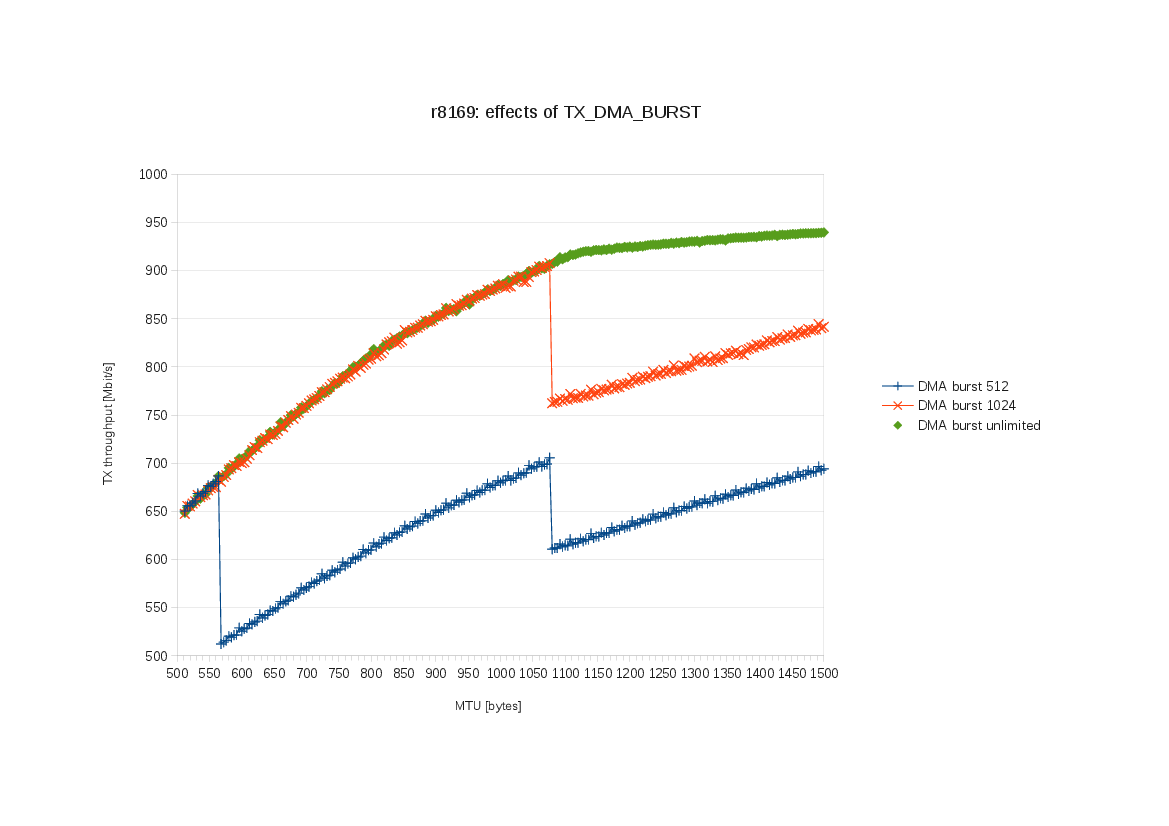
The r8169 driver currently limits the DMA burst for TX to 1024 bytes. I have
a box where this prevents the interface from using the gigabit line to its full
potential. This patch solves the problem by setting TX_DMA_BURST to unlimited.

The box has an ASRock B75M motherboard with on-board RTL8168evl/8111evl
(XID 0c900880). TSO is enabled.

I used netperf (TCP_STREAM test) to measure the dependency of TX throughput
on MTU. I did it for three different values of TX_DMA_BURST ('5'=512, '6'=1024,
'7'=unlimited). This chart shows the results:
http://michich.fedorapeople.org/r8169/r8169-effects-of-TX_DMA_BURST.png

Interesting points:
 - With the current DMA burst limit (1024):
   - at the default MTU=1500 I get only 842 Mbit/s.
   - when going from small MTU, the performance rises monotonically with
     increasing MTU only up to a peak at MTU=1076 (908 MBit/s). Then there's
     a sudden drop to 762 MBit/s from which the throughput rises monotonically
     again with further MTU increases.
 - With a smaller DMA burst limit (512):
   - there's a similar peak at MTU=1076 and another one at MTU=564.
 - With unlimited DMA burst:
   - at the default MTU=1500 I get nice 940 Mbit/s.
   - the throughput rises monotonically with increasing MTU with no strange
     peaks.

Notice that the peaks occur at MTU sizes that are multiples of the DMA burst
limit plus 52. Why 52? Because:
  20 (IP header) + 20 (TCP header) + 12 (TCP options) = 52

The Realtek-provided r8168 driver (v8.032.00) uses unlimited TX DMA burst too,
except for CFG_METHOD_1 where the TX DMA burst is set to 512 bytes.
CFG_METHOD_1 appears to be the oldest MAC version of "RTL8168B/8111B",
i.e. RTL_GIGA_MAC_VER_11 in r8169. Not sure if this MAC version really needs
the smaller burst limit, or if any other versions have similar requirements.

Signed-off-by: Michal Schmidt <mschmidt@redhat.com>
Acked-by: Francois Romieu <romieu@fr.zoreil.com>
Signed-off-by: David S. Miller <davem@davemloft.net>
Signed-off-by: Ben Hutchings <ben@decadent.org.uk>
commit b00e69dee4 upstream.

This regression was spotted between Debian squeeze and Debian wheezy
kernels (respectively based on 2.6.32 and 3.2). More info about
Wake-on-LAN issues with Realtek's 816x chipsets can be found in the
following thread: http://marc.info/?t=132079219400004

Probable regression from d4ed95d796e5126bba51466dc07e287cebc8bd19;
more chipsets are likely affected.

Tested on top of a 3.2.23 kernel.

Reported-by: Florent Fourcot <florent.fourcot@enst-bretagne.fr>
Tested-by: Florent Fourcot <florent.fourcot@enst-bretagne.fr>
Hinted-by: Francois Romieu <romieu@fr.zoreil.com>
Signed-off-by: Cyril Brulebois <kibi@debian.org>
Signed-off-by: David S. Miller <davem@davemloft.net>
Signed-off-by: Ben Hutchings <ben@decadent.org.uk>
commit 5f5b331d5c upstream.

The issue occurs when eCryptfs is mounted with a cipher supported by
the crypto subsystem but not by eCryptfs. The mount succeeds and an
error does not occur until a write. This change checks for eCryptfs
cipher support at mount time.

Resolves Launchpad issue #338914, reported by Tyler Hicks in 03/2009.
https://bugs.launchpad.net/ecryptfs/+bug/338914

Signed-off-by: Tim Sally <tsally@atomicpeace.com>
Signed-off-by: Tyler Hicks <tyhicks@canonical.com>
Signed-off-by: Ben Hutchings <ben@decadent.org.uk>
commit 069ddcda37 upstream.

When the eCryptfs mount options do not include '-o acl', but the lower
filesystem's mount options do include 'acl', the MS_POSIXACL flag is not
flipped on in the eCryptfs super block flags. This flag is what the VFS
checks in do_last() when deciding if the current umask should be applied
to a newly created inode's mode or not. When a default POSIX ACL mask is
set on a directory, the current umask is incorrectly applied to new
inodes created in the directory. This patch ignores the MS_POSIXACL flag
passed into ecryptfs_mount() and sets the flag on the eCryptfs super
block depending on the flag's presence on the lower super block.

Additionally, it is incorrect to allow a writeable eCryptfs mount on top
of a read-only lower mount. This missing check did not allow writes to
the read-only lower mount because permissions checks are still performed
on the lower filesystem's objects but it is best to simply not allow a
rw mount on top of ro mount. However, a ro eCryptfs mount on top of a rw
mount is valid and still allowed.

https://launchpad.net/bugs/1009207

Signed-off-by: Tyler Hicks <tyhicks@canonical.com>
Reported-by: Stefan Beller <stefanbeller@googlemail.com>
Cc: John Johansen <john.johansen@canonical.com>
Signed-off-by: Ben Hutchings <ben@decadent.org.uk>
[ Upstream commit 60713a0ca7 ]

As documented in RFC4861 (Neighbor Discovery for IP version 6) 7.2.6.,
unsolicited neighbour advertisements should be sent to the all-nodes
multicast address.

Signed-off-by: Hannes Frederic Sowa <hannes@stressinduktion.org>
Signed-off-by: David S. Miller <davem@davemloft.net>
Signed-off-by: Ben Hutchings <ben@decadent.org.uk>
[ Upstream commit a3d744e995 ]

Due to a NULL dereference, the following patch is causing oops
in normal trafic condition:

commit c0de08d042
Author: Eric Leblond <eric@regit.org>
Date:   Thu Aug 16 22:02:58 2012 +0000

    af_packet: don't emit packet on orig fanout group

This buggy patch was a feature fix and has reached most stable
branches.

When skb->sk is NULL and when packet fanout is used, there is a
crash in match_fanout_group where skb->sk is accessed.
This patch fixes the issue by returning false as soon as the
socket is NULL: this correspond to the wanted behavior because
the kernel as to resend the skb to all the listening socket in
this case.

Signed-off-by: Eric Leblond <eric@regit.org>
Signed-off-by: David S. Miller <davem@davemloft.net>
Signed-off-by: Ben Hutchings <ben@decadent.org.uk>
[ Upstream commit 789336360e ]

When creating an L2TPv3 Ethernet session, if register_netdev() should fail for
any reason (for example, automatic naming for "l2tpeth%d" interfaces hits the
32k-interface limit), the netdev is freed in the error path.  However, the
l2tp_eth_sess structure's dev pointer is left uncleared, and this results in
l2tp_eth_delete() then attempting to unregister the same netdev later in the
session teardown.  This results in an oops.

To avoid this, clear the session dev pointer in the error path.

Signed-off-by: Tom Parkin <tparkin@katalix.com>
Signed-off-by: David S. Miller <davem@davemloft.net>
Signed-off-by: Ben Hutchings <ben@decadent.org.uk>
[ Upstream commit 8f363b77ee ]

Reading TCP stats when using TCP Illinois congestion control algorithm
can cause a divide by zero kernel oops.

The division by zero occur in tcp_illinois_info() at:
 do_div(t, ca->cnt_rtt);
where ca->cnt_rtt can become zero (when rtt_reset is called)

Steps to Reproduce:
 1. Register tcp_illinois:
     # sysctl -w net.ipv4.tcp_congestion_control=illinois
 2. Monitor internal TCP information via command "ss -i"
     # watch -d ss -i
 3. Establish new TCP conn to machine

Either it fails at the initial conn, or else it needs to wait
for a loss or a reset.

This is only related to reading stats.  The function avg_delay() also
performs the same divide, but is guarded with a (ca->cnt_rtt > 0) at its
calling point in update_params().  Thus, simply fix tcp_illinois_info().

Function tcp_illinois_info() / get_info() is called without
socket lock.  Thus, eliminate any race condition on ca->cnt_rtt
by using a local stack variable.  Simply reuse info.tcpv_rttcnt,
as its already set to ca->cnt_rtt.
Function avg_delay() is not affected by this race condition, as
its called with the socket lock.

Cc: Petr Matousek <pmatouse@redhat.com>
Signed-off-by: Jesper Dangaard Brouer <brouer@redhat.com>
Acked-by: Eric Dumazet <edumazet@google.com>
Acked-by: Stephen Hemminger <shemminger@vyatta.com>
Signed-off-by: David S. Miller <davem@davemloft.net>
Signed-off-by: Ben Hutchings <ben@decadent.org.uk>
[ Upstream commit 39707c2a3b ]

Driver anchors the tx urbs and defers the urb submission if
a transmit request comes when the interface is suspended.
Anchoring urb increments the urb reference count. These
deferred urbs are later accessed by calling usb_get_from_anchor()
for submission during interface resume. usb_get_from_anchor()
unanchors the urb but urb reference count remains same.
This causes the urb reference count to remain non-zero
after usb_free_urb() gets called and urb never gets freed.
Hence call usb_put_urb() after anchoring the urb to properly
balance the reference count for these deferred urbs. Also,
unanchor these deferred urbs during disconnect, to free them
up.

Signed-off-by: Hemant Kumar <hemantk@codeaurora.org>
Acked-by: Oliver Neukum <oneukum@suse.de>
Signed-off-by: David S. Miller <davem@davemloft.net>
Signed-off-by: Ben Hutchings <ben@decadent.org.uk>
[ Upstream commit 14edd87dc6 ]

Commit a02e4b7dae4551(Demark default hoplimit as zero) only changes the
hoplimit checking condition and default value in ip6_dst_hoplimit, not
zeros all hoplimit default value.

Keep the zeroing ip6_template_metrics[RTAX_HOPLIMIT - 1] to force it as
const, cause as a37e6e344910(net: force dst_default_metrics to const
section)

Signed-off-by: Li RongQing <roy.qing.li@gmail.com>
Signed-off-by: David S. Miller <davem@davemloft.net>
Signed-off-by: Ben Hutchings <ben@decadent.org.uk>
[ Upstream commit a3374c42aa ]

tcp_ioctl() tries to take into account if tcp socket received a FIN
to report correct number bytes in receive queue.

But its flaky because if the application ate the last skb,
we return 1 instead of 0.

Correct way to detect that FIN was received is to test SOCK_DONE.

Reported-by: Elliot Hughes <enh@google.com>
Signed-off-by: Eric Dumazet <edumazet@google.com>
Cc: Neal Cardwell <ncardwell@google.com>
Cc: Tom Herbert <therbert@google.com>
Signed-off-by: David S. Miller <davem@davemloft.net>
Signed-off-by: Ben Hutchings <ben@decadent.org.uk>
[ Upstream commit 6d772ac557 ]

On some suspend/resume operations involving wimax device, we have
noticed some intermittent memory corruptions in netlink code.

Stéphane Marchesin tracked this corruption in netlink_update_listeners()
and suggested a patch.

It appears netlink_release() should use kfree_rcu() instead of kfree()
for the listeners structure as it may be used by other cpus using RCU
protection.

netlink_release() must set to NULL the listeners pointer when
it is about to be freed.

Also have to protect netlink_update_listeners() and
netlink_has_listeners() if listeners is NULL.

Add a nl_deref_protected() lockdep helper to properly document which
locks protects us.

Reported-by: Jonathan Kliegman <kliegs@google.com>
Signed-off-by: Eric Dumazet <edumazet@google.com>
Cc: Stéphane Marchesin <marcheu@google.com>
Cc: Sam Leffler <sleffler@google.com>
Signed-off-by: David S. Miller <davem@davemloft.net>
Signed-off-by: Ben Hutchings <ben@decadent.org.uk>
commit b0a8cc58e6 upstream.

In kswapd(), set current->reclaim_state to NULL before returning, as
current->reclaim_state holds reference to variable on kswapd()'s stack.

In rare cases, while returning from kswapd() during memory offlining,
__free_slab() and freepages() can access the dangling pointer of
current->reclaim_state.

Signed-off-by: Takamori Yamaguchi <takamori.yamaguchi@jp.sony.com>
Signed-off-by: Aaditya Kumar <aaditya.kumar@ap.sony.com>
Acked-by: David Rientjes <rientjes@google.com>
Signed-off-by: Andrew Morton <akpm@linux-foundation.org>
Signed-off-by: Linus Torvalds <torvalds@linux-foundation.org>
Signed-off-by: Ben Hutchings <ben@decadent.org.uk>